Songjiang Fengxian Taoist Temple: A Legacy Spanning Dynasties
As one of Shanghai’s historically influential Taoist sites, Songjiang Fengxian Taoist Temple’s rise and fall intertwined with the tides of time, bearing witness to the passage of the Yuan, Ming, and Qing dynasties. This temple not only preserves the region’s religious and cultural memory but also bears distinct marks of its eras through architectural renovations and expansions.
1.Location and Yuan Dynasty Founding: The Taoist Temple’s Beginnings in Caojing Town
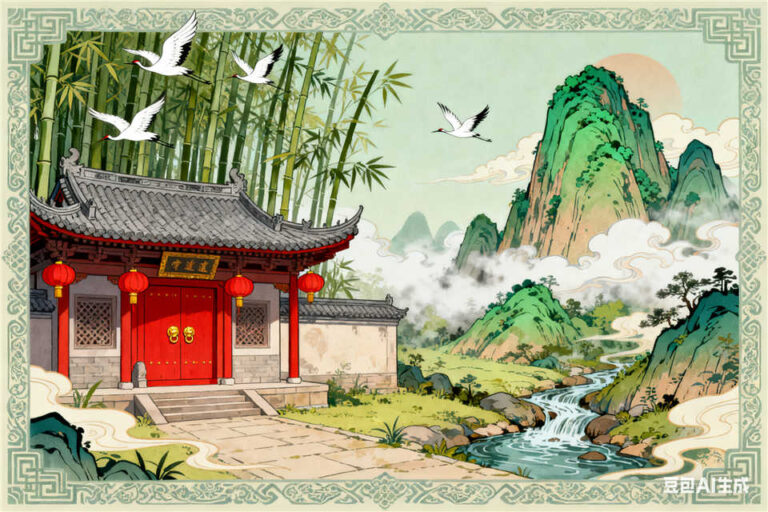
Situated in Caojing Town, southeast of Songjiang County, Shanghai, Fengxian Taoist Temple’s unique location deeply integrated it with local livelihoods and religious culture from its inception. During the Yuan Dynasty, Taoist culture spread widely across the Jiangnan region, providing the backdrop for Fengxian Taoist Temple’s emergence. Though limited historical records make it difficult to verify the exact scale of its architecture or worship arrangements during the Yuan Dynasty, as one of Caojing Town’s earliest religious sites, it undoubtedly provided local residents with a vital space for prayer and spiritual practice, laying the foundation for its subsequent development. At that time, Fengxian Taoist Temple may have been only a rudimentary, simple courtyard, yet it marked the beginning of its centuries-spanning historical journey.
2.Ming Dynasty: Decline, Reconstruction, and Expansion
The Ming Dynasty marked a pivotal period in Fengxian Taoist Temple’s history, characterized by cycles of destruction and rebuilding that gradually refined its layout. In the sixth year of the Yongle reign (1403), sudden Japanese pirate raids dealt a devastating blow to the temple. Its structures were destroyed in the conflict, and religious activities were suspended. It was not until the Zhengtong era (1436–1446) that local gentry Yang Zhen, driven by nostalgia for his homeland and devotion to his faith, funded the temple’s reconstruction. Building upon the original foundations, he established the Three Officials Hall and restored the name “Fengxian Daoyuan.” This initiative not only revitalized the temple but also ensured the continuity of Daoist culture in Caojing Town.
During the Chenghua era, Fengxian Taoist Monastery underwent another significant expansion. In the fifteenth year of Chenghua (1479), the abbot Lu Yongchu oversaw the construction of the Jade Emperor Hall and the renovation of the eastern and western wings, thereby completing the temple’s worship system and creating a more orderly architectural layout. The following year, Lu Yongchu also presided over the construction of the Bell and Drum Tower and the Outer Three Gates, as well as the Paofu Bridge, further enhancing the temple’s functional facilities. The establishment of the Bell and Drum Tower made the temple’s morning bells and evening drums a defining soundscape of Caojing Town. The construction of Paofu Bridge provided convenience for worshippers and travelers alike, strengthening the temple’s ties with surrounding communities. At this juncture, Fengxian Taoist Temple reached its zenith in both architectural scale and religious influence during the Ming Dynasty.
3.Qing Dynasty Reconstruction and Subsequent Decline: A Fading Chapter in History
Entering the Qing Dynasty, Fengxian Taoist Temple remained a subject of attention. In the 18th year of Emperor Kangxi’s reign (1679), Wang Zhen, a native of Xin’an, funded its reconstruction. This restoration served both to maintain the temple’s structures and to perpetuate the transmission of Taoist culture locally. Wang Zhen’s benevolent act enabled the temple, weathered by time, to be refurbished once more, continuing its religious and cultural functions.
However, with the passage of time, Fengxian Taoist Temple gradually declined. By the late Qing Dynasty, intensified social turmoil and shifts in the religious landscape led to waning efforts in its maintenance and development, ultimately resulting in its abandonment. Once a bustling place of worship with well-ordered structures, Fengxian Taoist Temple slowly faded from history’s spotlight, leaving only scattered historical records for later generations to recall its former glory.
The history of Songjiang’s Fengxian Taoist Temple is a local cultural narrative intertwining religious devotion, folk benevolence, and epochal transformation. From its founding in the Yuan Dynasty, through its rise and fall with subsequent renovations in the Ming Dynasty, to its final restoration and eventual abandonment in the Qing Dynasty, it stands not merely as a chronicle of a temple’s fortunes but as a mirror reflecting centuries of social and cultural evolution in Shanghai’s Songjiang region. It remains an indispensable part of the area’s historical and cultural memory.