Huating Penglai Taoist Monastery: The Rise, Fall, and Legacy of a Millennium-Old Taoist Sanctuary
Nestled in eastern Huating County, Shanghai, lies a sacred site bearing the millennia-old memory of Taoist culture—the Huating Penglai Taoist Monastery. Though its founding date remains unverifiable, it underwent multiple renovations and expansions throughout the Song to Qing dynasties, gradually becoming the core landmark of Taoist culture in the Huating region. Its developmental trajectory is not only the rise and fall of a Taoist temple but also a vivid microcosm of local religious cultural inheritance.
1.Historical Evolution: From Naming to Renovation Through the Ages
The historical thread of Huating’s Penglai Taoist Temple becomes increasingly clear in historical records from the Song Dynasty onwards. During the Song Dynasty’s Shaoxing era (1131–1161), the site gained its formal name “Penglai Taoist Temple” due to an auspicious event: “the earth yielded lingzhi mushrooms, revealing the pure yang energy.” This naming not only imbued the temple with mystical religious significance but also laid the cultural foundation for its subsequent development.
The Yuan Dynasty witnessed the monastery’s first major restoration. During the Zhi Yuan era (1264–1294), Taoist priest Li De’an oversaw reconstruction efforts. Unfortunately, the structures gradually deteriorated under the ravages of time. The Ming Dynasty marked the monastery’s golden age of development: a major renovation during the Hongwu era (1368–1398) revitalized it; During the Yongle era (1403–1424), the abbot Lu Daohong expanded its scale, adding two shrines—one dedicated to Wenchang on the left and another to the Pure Yang Lu Zu on the right. Subsequently, three halls each were constructed for the main and rear sanctuaries, housing statues of the True Martial Emperor and the Supreme Lord Laozi respectively, thereby enhancing the temple’s religious functionality. However, in the 14th year of the Zhengde reign (1519), the temple suffered lightning damage. Fortunately, Daoist priest Wei Dabo led his disciples in rebuilding it during the early Jiajing era. During the Wanli reign (1573–1619), Yu Ruwei added the Eight Immortals Shrine, enriching the temple’s architectural layout.
The Qing dynasty witnessed the temple’s continued expansion. In the 45th year of the Qianlong reign (1780), Taoist priest Dai Ruzhen raised funds to construct the Zitong Pavilion. Though destroyed by a typhoon the following year, local resident Qian Shimei promptly rebuilt it. Shortly thereafter, another local, Zhang Qingyuan, erected the Sanxiao Hall, further expanding the complex. In the 18th year of the Jiaqing reign (1813), Taoist priest He Danshan raised funds to build the Liji Rear Hall. Through repeated repairs and expansions spanning the Song, Yuan, Ming, and Qing dynasties, the Daoist temple ultimately formed a substantial architectural complex, becoming a profoundly influential Daoist sanctuary in the Huating region.
2.Architectural Layout: Functional Refinement from Simplicity to Complexity
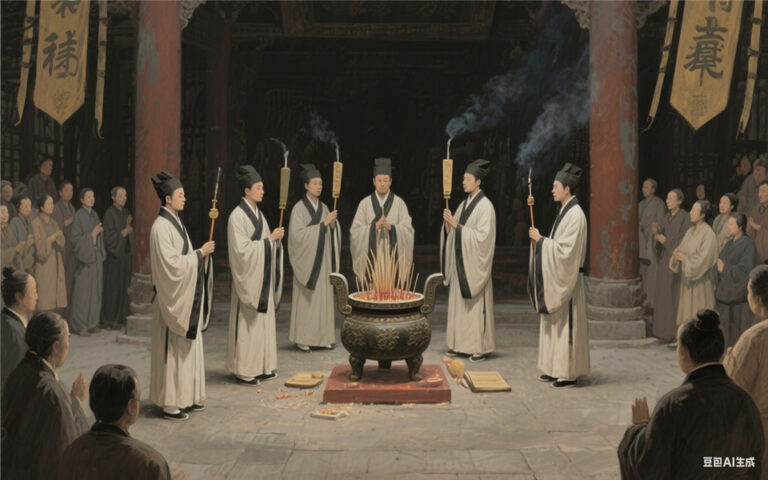
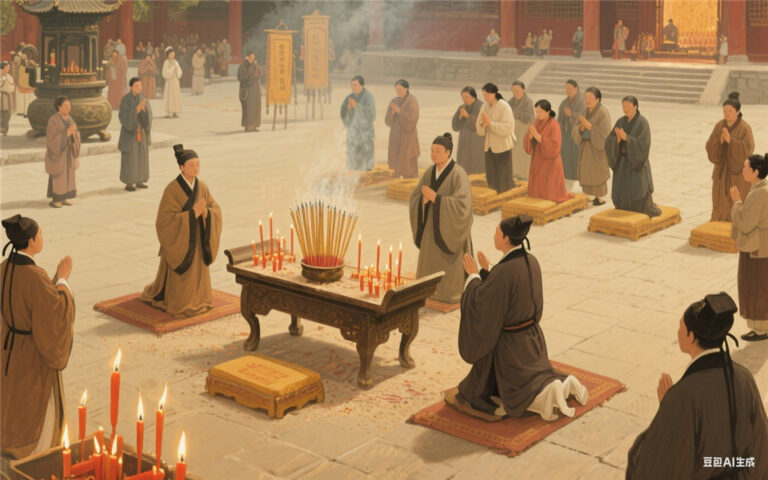
The architectural layout of Huating’s Penglai Daoist Temple consistently revolved around religious ritual functions, continuously evolving with the times. The exact scale of the early monastery remains unknown. The critical transformation occurred during the Yongle era of the Ming Dynasty under the abbot Lu Daohong: his construction of the “Two Shrines” established distinct zones for venerating Taoist deities. Wenchang and the Pure Yang Lü Zu were placed on the left and right respectively, aligning with Taoist belief systems while facilitating worship by devotees. Subsequently added were the Main Hall (honoring the True Martial Emperor) and the Rear Hall (honoring the Supreme Lord Laozi), establishing the core layout of “primary worship in the front hall, auxiliary worship in the rear hall.” The True Martial Emperor, as the guardian deity of the North in Taoism, and the Supreme Lord Laozi, as the progenitor of Taoism, were venerated together, highlighting the monastery’s orthodoxy and authority.
The addition of the Eight Immortals Shrine during the Wanli era infused the temple with elements of folk Taoist culture. The legend of the Eight Immortals was widely circulated among the populace, and the construction of this shrine transformed the temple from a purely orthodox Taoist worship site into a space that resonated more deeply with popular beliefs. During the Qing Dynasty, the successive construction of the Zituo Pavilion (dedicated to the Lord of Zituo, patron of literary fortune), the Three Xiao Hall (honoring the Three Xiao Ladies, patrons of fertility and good fortune), and the Rear Hall of Benevolence (presumably associated with prayers for blessings and worldly aid) further expanded the temple’s functional scope— — from imperial examination success to public welfare, from religious rites to benefiting the people. The refined architectural layout allowed the Taoist temple’s influence to permeate multiple facets of local life.
3.Cultural Significance: Spiritual Landmark of Huating Taoist Culture
As a “major sacred site” of Huating Taoism, Penglai Taoist Temple’s cultural significance far exceeds that of a mere religious structure. From a religious continuity perspective, since its naming in the Song Dynasty, it has embodied the core Taoist belief in “auspicious omens and divine manifestations.” The deities venerated through the ages—including Wenchang, Pure Yang Lü Zu, the Great Emperor Zhenwu, and the Supreme Lord Laozi—encompassed diverse branches of the Taoist pantheon, making it a vital site for local adherents to understand Taoist culture and practice their faith.
Regarding social value, the temple’s successive renovations relied on the joint efforts of Taoist priests and local communities. The stewardship of figures like Li De’an in the Yuan Dynasty, Lu Daohong in the Ming Dynasty, and Dai Ruzhen in the Qing Dynasty demonstrated Taoists’ steadfast commitment to their sacred site. Meanwhile, the reconstruction funded by local residents such as Qian Shimei and Zhang Qingyuan during the Qing Dynasty reflected the community’s recognition of the temple’s cultural significance. This model of “priest-led, community-participatory” development has made Daoist temples a vital bridge connecting religious groups with ordinary citizens, driving the dissemination and preservation of Daoist culture within the populace.