Shanghai Leizu Temple: A Lost Architectural Treasure of Antiquity
In the northeastern corner of Shanghai County, south of Danfeng Tower, once stood a Taoist temple that sustained centuries of incense offerings—Shanghai Leizu Temple. As a significant religious site in the Shanghai region during the Ming and Qing dynasties, it endured a tumultuous history of founding, expansion, restoration, and destruction. Though most of its structures have vanished, the surviving historical traces still offer crucial clues for studying Shanghai’s local religious culture and ancient architectural history.
1. Historical Development: A Century of Foundational Growth from Inception to Prosperity
The construction of Shanghai Leizu Temple was not completed overnight but evolved gradually over decades. Its origins trace back to the 26th year of the Qianlong reign (1761), when the temple was formally established, laying the groundwork for its future expansion. At this stage, however, the complex remained modest in scale, serving only basic religious functions.
In the 52nd year of Qianlong (1787), the temple underwent its first major expansion, extending its architectural layout and gradually increasing its religious influence. The temple truly attained its full scale with the addition of the front hall and mountain gate by Li Yunjia in the 55th year of Qianlong (1790). As an influential local figure, Li Yunjia’s additions not only perfected the temple’s ceremonial spaces—creating a harmonious relationship between the front hall and main hall—but also established the mountain gate, enhancing the complex’s sense of architectural hierarchy. This elevated Lei Zu Temple from an ordinary religious site to a Taoist temple with a complete ritual layout, making it one of the iconic structures in the northeastern part of Shanghai County.
2. Architectural Layout: Functional Zones and Spatial Characteristics
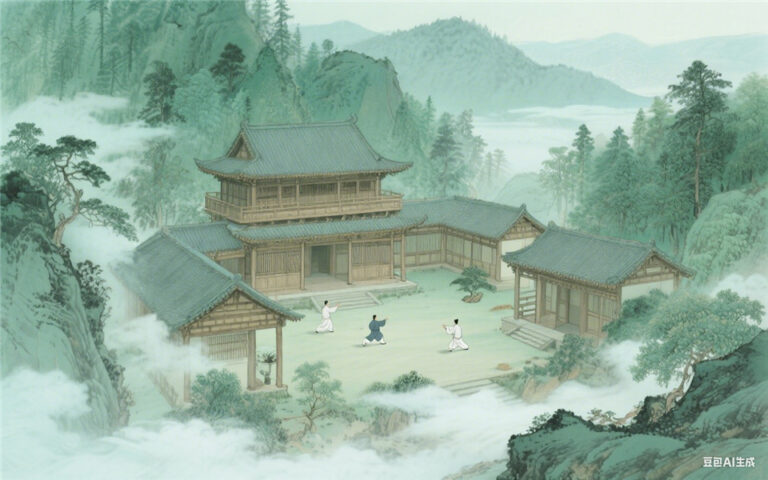
According to extant historical records, the architectural layout of Leizu Temple adheres to traditional Taoist palace-temple regulations while incorporating regional characteristics of the Jiangnan area. The core structures comprise three sections: the front hall, the main hall, and the western pavilion. The front hall and mountain gate form the ceremonial entrance space, serving as the first stop for devotees entering to pray for blessings. The main hall is the central sanctuary dedicated to the worship of the Thunder Deity, once housing the deity’s statue and related ritual implements. Its architectural form is solemn, with beams and brackets possibly adorned with painted Taoist motifs. The western pavilion was constructed in the fifth year of the Jiaqing reign (1800) through fundraising by the resident Taoist priest. It likely served multiple functions including residence, storage, and support for religious activities. The addition of this pavilion also enriched the spatial hierarchy of the complex.
The overall site selection near Danfeng Tower leveraged the bustling northeast district of the county town while providing devotees with a relatively tranquil environment for prayer, embodying the traditional architectural wisdom of “finding tranquility amid the bustle.”
3. Restoration and Destruction: Weathering the Storms of Time
Over its two-century history, Leizu Temple endured multiple cycles of restoration and destruction due to natural deterioration and social upheavals. A documented major reconstruction occurred in the third year of the Xianfeng reign (1853), coinciding with the Taiping Rebellion’s impact on the Jiangnan region. War likely caused significant damage to the temple. This restoration not only repaired the damaged structures but also ensured the temple’s incense offerings continued through turbulent times.
However, with the dramatic transformation of Shanghai’s urban landscape in modern times, particularly the gradual redevelopment and modernization of Shanghai County, the Lei Zu Temple could not escape destruction. Although the exact date and cause of its destruction lack detailed historical documentation, it is certain that under the dual pressures of time’s erosion and urban development, most structures of this once-thriving Taoist temple have vanished. It now survives only in local historical records and the memories of older Shanghai residents, becoming a lost architectural treasure buried in the passage of time.
4. Historical Value: A Significant Imprint of Shanghai’s Local Culture
Though the full appearance of Leizu Temple is now difficult to discern, its value within Shanghai’s local historical and cultural context remains undeniable. From a religious perspective, it stands as a tangible testament to the development of Taoism in Shanghai during the Ming and Qing dynasties, reflecting the folk beliefs and customs surrounding the worship of Leizu at that time. It provides a crucial case study for researching the dissemination of Taoist culture in the Jiangnan region. Architecturally, its layout and form blend traditional Taoist temple regulations with Jiangnan architectural characteristics, serving as a vital reference for studying Ming and Qing dynasty architectural styles in Shanghai. From an urban historical perspective, the rise and fall of Leizu Temple is closely intertwined with the development of Shanghai County, bearing witness to the early stages of Shanghai’s transformation from a traditional county town to a modern metropolis. It remains an integral part of the city’s collective memory.
Though the temple’s former grandeur is now lost to time, tracing its historical trajectory and cultural significance allows us to sense the weight of history it bore. This legacy offers valuable insights for preserving and perpetuating Shanghai’s local cultural heritage.