What truly constitutes failure? Taoist wisdom offers a different perspective
When most people hear the word “failure,” they think of career setbacks, unmet goals, or finishing last in competition. Yet in Taoist thought, true failure never lies in external outcomes of winning or losing—it stems from turning away from the Dao within. When we dissect the essence of “failure” through the wisdom of the Tao Te Ching and Zhuangzi, we discover that what we often perceive as ‘loss’ is merely a phase of life’s adjustment. True “defeat,” however, lies hidden in our cognition and character.
1. Defying “Nature”: Forcing action against the flow is the first step toward failure
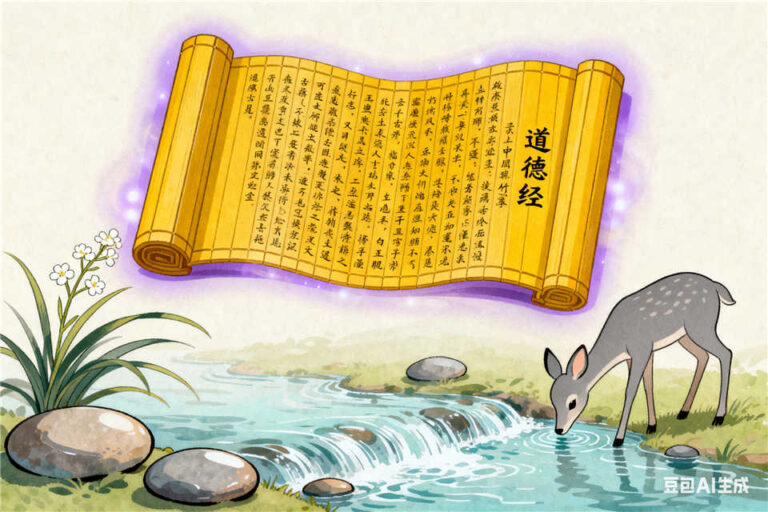
A core tenet of Taoism is “following the Way of Nature,” asserting that all things follow inherent rhythms—like the seasonal cycles and day-night alternations—which cannot be forcibly reversed. The Dao De Jing’s adage, “A gale does not last through the morning; a downpour does not last through the day,” reminds us: any act defying natural laws cannot endure, marking the beginning of failure.
In life, some pursue instant success by ignoring the natural rhythm of development—expecting a prolific literary output after just learning to write, or overnight wealth after starting a business. They “sprint” by sacrificing health and defying rules, only to end up either physically broken or with their ventures collapsing. This isn’t “bad luck,” but a fundamental misdirection from the start: mistaking ‘forcing’ for “effort,” and “fighting against the flow” for “breakthrough.”
In Taoist philosophy, true “success” is like water: “benefiting all things without contention.” It means aligning with natural laws without passive waiting. Just as farmers don’t force seeds to sprout in winter, but instead plant and irrigate according to the seasons, patiently awaiting harvest. If you defy “nature,” even if you temporarily achieve your desired outcome, it will be lost due to unstable foundations. This is the most fundamental failure.
2. Obsession with “gain and loss”: Fixation on outcomes is a deeper failure
The Zhuangzi recounts the tale of the “King of Chu’s Lost Bow”: While touring, the king misplaced his bow. When his attendants sought to retrieve it, he laughed and said, “A Chu man lost it; a Chu man will find it. Why bother searching?” This magnanimity toward “gain and loss” embodies the Daoist approach to overcoming failure—true defeat lies not in losing something, but in being trapped by the obsession with “loss,” thereby halting one’s progress.
Many people, after experiencing a setback, sink into self-denial: “I’m not capable,” “I’ll never succeed.” For instance, abandoning studies after exam failure or dismissing one’s abilities after a project’s collapse equates a single outcome with one’s entire life. Taoism teaches that “things have their roots and branches, affairs their beginnings and ends.” Momentary gains or losses are mere ripples in life’s river; fixating on their size means missing the entire landscape.
Consider Tao Yuanming, who resigned from officialdom to live in seclusion. To the world, this was a “failure in his career,” yet by following his true nature and returning to the fields, he penned the timeless verse: “Picking chrysanthemums beneath the eastern fence, I casually gaze upon the southern mountain.” He lived a life of spiritual freedom. Thus, only by freeing oneself from the shackles of “gain and loss” can one maintain clarity amidst life’s fluctuations. If trapped by obsession, even abundant possessions bring suffering born of fear of loss—this is the ultimate spiritual failure.
3. Losing One’s “True Self”: Sacrificing Authenticity to Please Others Is Ultimate Failure
Daoism emphasizes “embracing simplicity and purity, reducing selfish desires,” viewing humanity’s original nature as pristine and precious like unpolished jade. True failure occurs when, in pursuit of external validation, one gradually smooths away the edges of their true self, becoming someone they no longer recognize.
Some chase so-called “success” by mimicking others’ paths: when others take civil service exams, they follow suit; when others pursue high salaries, they abandon their beloved fields. What appears as ‘effort’ is actually drifting aimlessly, losing oneself in the current. As the Tao Te Ching states, “To know others is wisdom; to know oneself is enlightenment.” True wisdom lies in recognizing one’s true nature, not blindly following others’ footsteps.
Like ancient recluses, they remain unmoved by fame and fortune, guarding inner tranquility. Though seemingly “out of step with the times,” they preserve their most precious selves. Those who abandon their true nature to please others may gain wealth and status, yet feel emptiness in the dead of night—for while they win external approval, they lose their authentic selves. This is the most profound failure.