Can a soul “complete” its journey, cease reincarnation, and remain in the realm of souls?
In Daoist perspectives on life and death, the soul’s destiny is never a simple cycle of reincarnation. Unlike certain religions’ dogmatic assertions about the “final abode of the soul,” Daoism, rooted in Yin-Yang philosophy, charts a path for the soul’s evolution—one that can be altered through personal cultivation. So, can a soul “complete” a certain mission, cease reincarnation, and dwell permanently in the realm beyond the cycle of rebirth? The answer lies in Taoism’s profound insight into the essence of life.
1. The Essence of the Soul: The Eternal Flow of Yin and Yang Energies
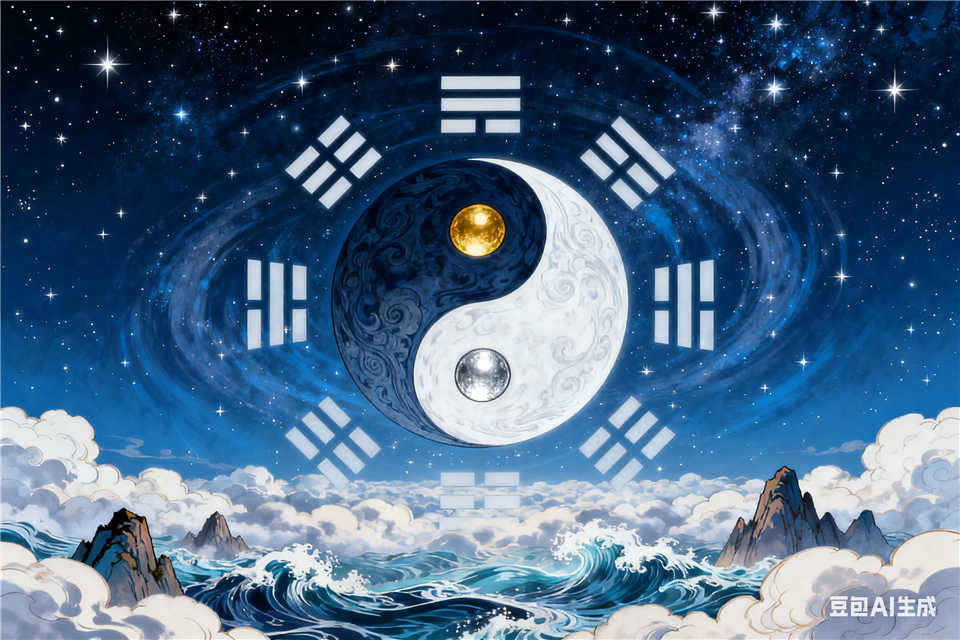
Taoism holds that humans are a union of yin and yang energies: “Heavenly energy forms the soul, earthly energy forms the spirit.” The soul (hun) belongs to yang, representing the formless spiritual consciousness; the spirit (po) belongs to yin, existing in attachment to the physical body. After death, the physical form and spirit return to the earth, turning to dust, while the soul’s energy ascends to heaven, becoming a continuing spiritual entity. This concept of “the soul’s energy ascending to heaven, the physical form and spirit returning to earth” forms the foundation of Daoist views on the soul.
In the “On the Equality of All Things,” Zhuangzi describes ordinary people as “their souls commune in sleep,” viewing dreams as manifestations of the soul’s nocturnal activity. In contrast, the enlightened “True Person” attains the state of “sleeping without dreaming,” as their soul has transcended worldly disturbances, dwelling in a state of tranquil purity. This illustrates that the soul’s condition is not fixed but transforms with the elevation of one’s life realm.
2. The Truth of Reincarnation: The Rise and Fall of Virtue and Vice Across the Five Realms
Daoism’s reincarnation system centers on the “Five Realms”: the Divine Realm, Human Realm, Animal Realm, Hungry Ghost Realm, and Hell Realm. The Scripture of the Supreme Lord Laozi on the Origin of Emptiness and Naturalness explicitly states that beings in these five realms “each have their own lifespan,” all caught in the cycle of birth and death. Beings rise and fall within these realms based on the karmic forces of good and evil: those who cultivate virtue ascend with their merits, while evildoers descend with their sins—this embodies the principle of “heavenly retribution.”
The cycle of the Five Realms is not an eternal prison but a process of spiritual refinement for souls lost in delusion. Daoist scriptures emphasize that all five realms are “places of delusion, desire, confusion, and loss of true nature,” not destinations worth dwelling in. The soul’s transmigration through reincarnation is fundamentally a temporary state driven by karmic forces of good and evil, not an unalterable fate. As the Scripture of the Western Ascent states, “My destiny lies within me, not in heaven or earth”—the soul’s ultimate destination rests in its own hands.
3. Paths to Liberation: From the Six Bridges and Golden Bridge to Union with the Tao
Taoism charts a course for souls to transcend reincarnation. Within the doctrine of the “Six Bridges,” the Golden Bridge is reserved for those who “cultivate immortal arts and accumulate vast merit.” Crossing this bridge enables one to “ascend to immortality or attain Taoist enlightenment,” achieving complete liberation from the cycle of rebirth. This liberation does not mean entering a fixed “realm of souls,” but rather attaining the state of “becoming one with the Dao”—the ultimate goal pursued by Daoism.
The cultivation process is one of continuous purification and strengthening of the soul. Zǐ Chǎn once said: “When one’s essence is abundant, the soul and spirit grow strong. Thus, one possesses vitality and reaches the realm of divine enlightenment.” Through Taoist cultivation and the accumulation of merit, the soul (spiritual essence) gradually sheds the bonds of yin impurities, attaining a state of pure yang. When the soul fully harmonizes with the Great Dao, reincarnation becomes unnecessary. As the Taiping Jing states, practicing virtue enables “the spirit to commune with Heaven, thereby attaining longevity and immortality.”
4. The Eternal Abode: Not Within Realms, But Within the Dao
Daoism does not posit a fixed “soul realm” as the ultimate destination. The soul’s ‘fulfillment’ lies not in entering some space, but in returning to the source of life. When the soul completely sheds desire and attachment, merging with the formless Dao, it achieves the ultimate state of “refining emptiness to unite with the Dao,” naturally freeing itself from reincarnation.
This liberated state, as Zhuangzi described, is “Heaven and Earth coexist with me, and all things are one with me.” The soul is no longer bound by the five realms’ cycles but becomes part of the Dao itself, as the Wenzi states, “ascending to unite with the Supreme One.” This is not the soul dwelling in any realm but transcending the limitations of time, space, and states to attain true eternity.
Daoism shatters superstitions about predestination through the conviction that “my destiny lies within me.” Whether a soul ceases reincarnation depends not on external judgment, but on its ability to return to its authentic self through cultivating the mind and refining the nature. When life fully awakens to the Dao, the cycle of rebirth naturally ceases—not because the soul finds some resting place, but because it realizes it has always been one with the eternal Dao.