Fengxian Dan Zhen Taoist Temple: A Hidden Legend in the Jiangnan Taoist Tradition
Nestled within the historical folds of the ancient town of Nanqiao in Fengxian District, Shanghai, once stood a Taoist temple known as the “Dan Zhen Taoist Temple.” Founded in the sixth year of Emperor Kangxi’s reign (1662) during the Qing Dynasty, this Daoist temple endured over three centuries of vicissitudes before fading into obscurity. Yet, in the scattered records of local annals, it left behind a touching tale of faith and construction.
I. Founding: The Serendipitous Encounter Between Local Gentry and the Daoist Tradition
The establishment of the Dan Zhen Daoist Temple was closely tied to the social and cultural context of Fengxian during the early Qing Dynasty. In the early years of the Kangxi reign, after the turmoil of the late Ming Dynasty, the Jiangnan region gradually stabilized, and the local gentry class emerged as a significant force driving local cultural development. According to the Qing Dynasty’s Qianlong-era “Fengxian County Annals,” local residents Zou Tinglin and Xia Zisi, among others, were inspired by the feng shui layout east of Mingxing Temple and pooled their resources to build this Daoist temple.
Although Zou Tinglin’s identity is not recorded in official history, his status as a “local resident” suggests he was an influential local gentry. His choice to build the Daoist temple east of Mingxing Temple carries the cultural implication of coexistence between Buddhism and Daoism. Mingxing Temple, founded during the Wu Yue Kingdom period of the Five Dynasties, is one of the oldest temples in Fengxian, and the land east of it is considered a feng shui-favorable site. The construction of the Daoist temple was not only the establishment of a religious site but also a means for local elites to assert their influence in the local society through the creation of a cultural space.
II. Renovation: The Spiritual Vigilance of Daoists and Believers
In the sixth year of the Yongzheng reign (1728), the appearance of Daoist monk Chu Eiting brought new vitality to the Daoist temple. This Daoist, whose name is the only record left in local annals, raised funds through donations and carried out a comprehensive renovation of the Daoist temple. The renovation not only included the main buildings such as the main hall and gatehouse but also added three “Wuyun Lou” (Cloud-Resting Pavilions), making the temple’s layout more complete.
Chu Eiting’s renovation project reflected the development trend of Daoism in the Jiangnan region during the mid-Qing Dynasty. At this time, Daoism was gradually moving from the upper classes to the common people, with Daoist priests deeply involved in local social life through activities such as overseeing the renovation of temples and holding religious ceremonies. The addition of the Wuyun Lou provided a place for Daoist priests to practice asceticism and also became an important space for believers to participate in religious activities. The creation of this religious space was essentially a reflection of Daoism’s adaptation to the religious needs of the common people.
III. Architecture: Taoist Imagery in Jiangnan Water Towns
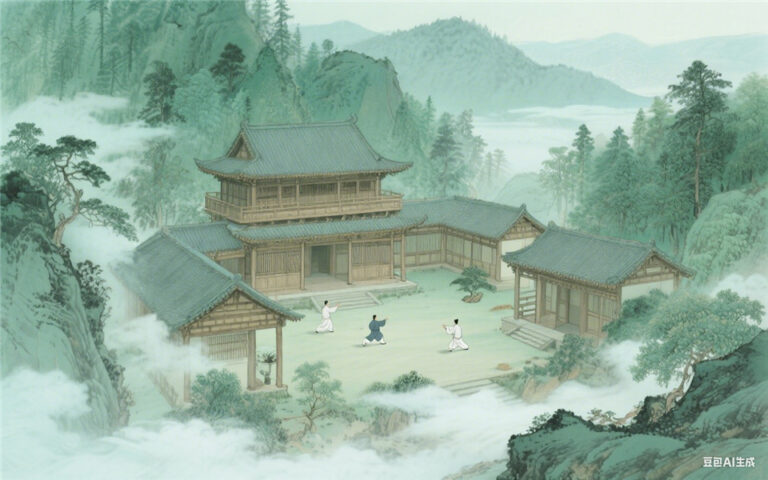
Although there are no detailed records of the architectural style of the Dan Zhen Taoist Temple, it can be reasonably inferred from the characteristics of contemporary Taoist architecture in the Jiangnan region. The main building likely followed the traditional central axis layout, with the main hall housing the Three Pure Ones, while the side halls may have housed deities such as the God of Wealth and Wenchang, who are revered in folk beliefs. The Wuyun Pavilion, added during the Yongzheng era, may have been a two-story pavilion-style structure, serving both as a vantage point for scenic views and as a place for storing scriptures and spiritual practice.
Notably, the academy’s former name, “Nanchenghuang Temple,” suggests its connection to local city god worship. During the Ming and Qing dynasties, City God Temples often served both religious and secular functions, functioning as both places for the public to pray for blessings and ward off disasters, as well as important nodes in local social governance. The alternative name of the Dan Zhen Daoist Temple reflects the deep integration of Daoist temples and folk beliefs, a phenomenon particularly prominent in the Jiangnan region.
IV. Obscurity: Cultural Deposits in the Flow of History
The exact time and reasons for the abandonment of the Daoist temple are difficult to verify, but insights can be gained from the fate of other religious sites in the Fengxian region. The wars of the Xianfeng era, the social upheavals of the late Qing and early Republican periods, and the impact of modern urbanization may have contributed to its gradual decline. By the mid-20th century, the temple’s structures had completely vanished, leaving only the name “Dan Zhen Daoist Temple” recorded in local annals.
However, the spiritual influence of the Daoist temple has not completely faded. The Nanqiao area where it was located still preserves religious sites such as Mingxing Temple and Shangzhen Daoist Temple, forming a unique religious and cultural landscape in Fengxian. In 2016, the Mid-Autumn Festival Fair at Shangzhen Daoist Temple was listed as a Fengxian District Intangible Cultural Heritage, and this living tradition is a continuation and tribute to the Jiangnan Daoist culture, including Dan Zhen Daoist Temple.
V. Aftermath: Cultural Memories in Local Chronicles
The history of the Dan Zhen Daoist Temple is a microcosm of the numerous small and medium-sized Daoist temples in the Jiangnan region. Though they may not be as prominent as the famous mountain temples, they play an indispensable role in local society. From its founding during the Kangxi era, to its renovation during the Yongzheng era, and its eventual decline in later generations, the fate of the Dan Zhen Daoist Temple reflects the interactive relationship between religion and local society.
Under the efforts of the Fengxian District Taoist Association, research and documentation of local Taoist culture have deepened in recent years. This cultural awareness allows us to rediscover such obscure entities as the Dan Zhen Taoist Temple. They are like scattered pearls, linking the religious and cultural threads of Fengxian District and providing a precious historical example for contemporary people to understand the Taoist tradition of Jiangnan.
Today, standing in the alleys of Nanqiao Ancient Town, one may no longer find traces of the Dan Zhen Daoist Temple. However, its legacy lives on in the annals of local histories and in the oral traditions passed down through generations.
V. Aftermath: Cultural Memories in Local Chronicles
The history of the Dan Zhen Taoist Temple is a microcosm of the numerous small and medium-sized Taoist temples in the Jiangnan region. Though they may not be as renowned as the grand temples on famous mountains, they play an indispensable role in local society. From its founding during the Kangxi era, to its renovation during the Yongzheng era, and its eventual decline in later generations, the fate of the Dan Zhen Taoist Temple reflects the interplay between religion and local society.
Under the efforts of the Fengxian District Taoist Association, research and documentation of local Taoist culture have deepened in recent years. This cultural awareness has enabled us to rediscover such obscure entities as the Dan Zhen Taoist Temple. Like scattered pearls, they connect the religious and cultural threads of Fengxian District and provide valuable historical examples for contemporary understanding of the Taoist tradition in Jiangnan.