Jinshan City God Temple: A Sacred Imprint of the Maritime Frontier’s Defensive City
In the northeast of Jinshanwei Town, Jinshan District, Shanghai, once stood a Taoist temple that witnessed the rise and fall of the maritime frontier—the Jinshan City God Temple. Constructed in the 20th year of the Hongwu era (1387) during the Ming Dynasty, this temple emerged alongside Jinshanwei’s military defense system. Over six centuries, it underwent multiple restorations and witnessed cycles of prosperity and decline, becoming a vital origin of city god culture in the Shanghai region.
1.The Twin Paths of Fortress and Temple
The birth of Jinshan City God Temple is deeply rooted in the context of Ming Dynasty maritime defense construction. In the 19th year of the Hongwu era (1386), to resist Japanese pirate incursions, the imperial court ordered the construction of Jinshanwei. The following year, a site northeast of the garrison city was selected to build the City God Temple, forming a symbiotic pattern of military governance and religious belief: “Where there is a garrison, there is a city; where there is a city, there is a city god to oversee it.” Temple keeper Dong Qi initiated the first fundraising campaign for repairs in the 30th year of the Hongwu era (1397), marking the beginning of successive generations of temple renovations.
In the ninth year of Xuande (1434), Commander Xi Gui oversaw the creation of divine statues. During the Zhengtong era, his younger brother Xi Xian expanded the temple by adding two wings and three gates, establishing its initial scale. The reconstruction led by Governor-General Yang Zheng in the fourth year of Hongzhi (1491) proved pivotal, not only achieving “a complete renewal with fully developed regulations and standards” but also leaving behind stele inscriptions documenting the renovation process. During the Kangxi reign of the Qing dynasty, Deputy Commander Wang Gongjian oversaw another major renovation. Completed in six months, it upgraded the structure to a “double-eaved roof with arched eaves, lofty walls, and ornate steps”—the last large-scale restoration recorded in historical sources.
2.The Aesthetics of Defense in a Five-Courtyard Layout
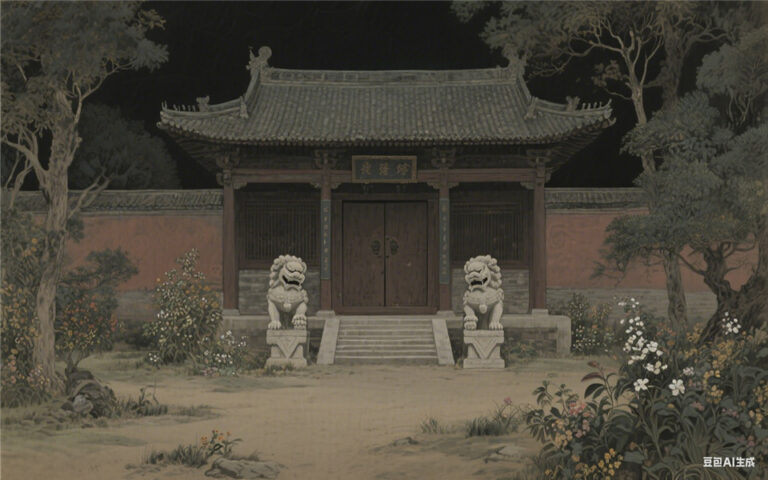
Archaeological evidence indicates that Jinshan City God Temple adopted the Southern Grand Style architecture, featuring a five-courtyard layout that integrated military defense with religious worship functions. A protruding wall over ten feet tall stood south of the temple’s front street, inscribed with the characters “Great Ming Reigns Over All Under Heaven” alongside admonitions urging “honest officials and brave generals” and “diligent citizens and frugal administrators,” skillfully blending political ethics with divine belief.
Twin flagpoles, each 5.7 zhang tall, stand on either side of the temple grounds, simultaneously symbolizing divine authority and serving as lookout points. Along the central axis, structures are sequentially arranged: the main gate, secondary gate, opera stage, and main hall. The addition of two wings and three gates during the Zhengtong era aligns with Daoist doctrine of “three gates connecting three realms” while subtly echoing the spatial layout principles of a defensive citadel. This architectural ingenuity enabled the temple to fulfill ritual requirements while serving as a symbol of the citadel’s spiritual defense.
3.From Prosperous Worship to Heritage Continuity
As the provincial capital’s city god temple for Jiangsu and Zhejiang, Jinshan City God Temple once enjoyed thriving worship. Its enshrined statue of Western Han General Huo Guang became a pivotal symbol of Shanghai’s city god faith. Annual temple fairs held on the fifteenth day of the seventh lunar month (Huo Guang’s birthday) and the first day of the tenth lunar month (his death anniversary) attracted merchants from Zhejiang, Fujian, Guangdong, and Shandong, creating scenes so bustling that “sails and masts stretched endlessly, as if walking on the temple steps.”
The exact date of this ancient temple’s eventual abandonment remains unclear, but it is believed linked to the decline of its status as a rear-guard city during the peaceful Qing dynasty maritime borders and the frequent wars of the modern era. Though its ruins now serve as a military base, its cultural legacy remains deeply embedded in Shanghai’s urban fabric. During the Ming Dynasty’s Yongle era, when Magistrate Zhang Shouyue converted the city’s Jinshan Shrine into a City God Temple, he preserved the tradition of venerating Huo Guang. This established the unique layout seen in Shanghai’s City God Temple today: the front hall honors Huo Guang, while the rear hall venerates Qin.
The rise and fall of Jinshan City God Temple mirrors a condensed history of Shanghai’s maritime frontier development. From its origins as the military-religious heart of a Ming-era defensive city to becoming one of the sources of Shanghai’s city god culture, this vanished temple leaves behind not only architectural ruins but also the coastal populace’s spiritual anchor for “protecting the nation and securing the realm.” It offers a valuable historical perspective for contemporary research on Ming-Qing maritime defense and folk beliefs.