Qiyun Mountain Taisu Palace: The Mysterious Realm of the Taoist Gate Amidst the Clouds and Mist
Deep within the Qiyun Rock Mountains, fifteen kilometers west of Xiuning City in Anhui Province, mist often swirls like a light veil around the ruins of a red-walled, black-tiled structure. This is the Taosu Palace, once hailed as the “First Taoist Palace of Jiangnan.” Nestled among the Danxia peaks, this Taoist sanctuary has borne the imperial incense of the Ming and Qing dynasties and witnessed the thousand-year evolution of Taoist culture amidst the mountains and waters of southern Anhui.
In the 35th year of the Jiajing reign of the Ming Dynasty, when the imperial edict “Xuantiantaisu Palace” was hung above the palace gates, this Taoist temple was destined to be inextricably linked to the imperial family. Legend has it that Shao Yuanjie, the Zhenyi Sect master of Longhushan Mountain, had merited the emperor’s favor by praying for an heir for the emperor, and thus petitioned to have a palace built on Qiyun Mountain to venerate the Supreme Emperor of the North. The craftsmen built the palace along the contours of Qiyun Rock, incorporating the Daoist concept of “unity between heaven and humanity” into every detail of the eaves and brackets. The result is a grand architectural complex spanning over 1,600 square meters, facing north.
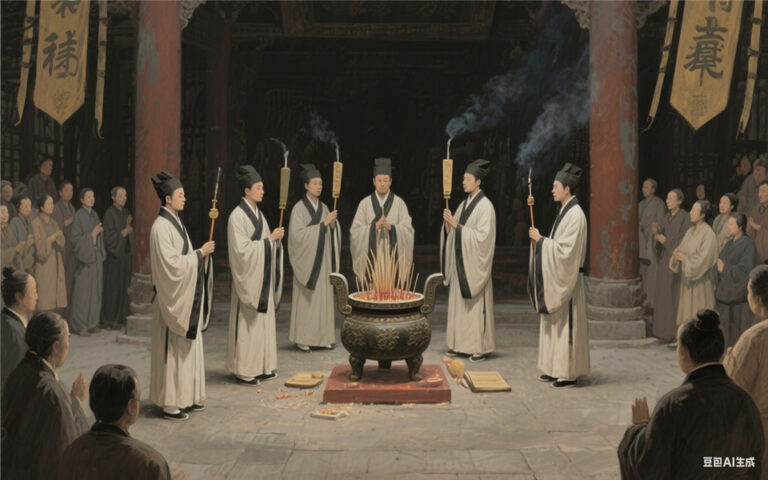
Passing through the “Xuantianginque” stone archway, one enters the secret realm of the Taisu Palace. This four-pillar, three-story stone archway features dragon-patterned column bases, with cloud patterns meticulously carved by Ming Dynasty artisans, evoking the once-thriving scene of pilgrims and fluttering banners. The front hall within the palace gates once housed the deities of Taoist protection. Through the carved lattice windows, the bronze statue of the Supreme Emperor of the North in the main hall comes into view—legend has it that this statue weighs a thousand catties, with its gilded robes shimmering with solemn radiance in the candlelight. The rear hall was where Taoist monks recited scriptures and practiced meditation. Perhaps an elderly monk once burned incense and sat in meditation here, with the mountain breeze rustling through the pine trees outside, blending with the chanting to create a mystical melody.
The renovation in the 33rd year of the Qianlong reign of the Qing Dynasty infused new vitality into this ancient temple. Craftsmen repaired the weathered stone carvings and repainted the faded murals. The colorful paintings depicting the lineage of Taoist deities still retain their vibrant colors after a century. The guest halls and dining halls on either side of the palace once hosted countless pilgrims. The morning bells and the chanting of the Taoist priests echoed through the valleys of Qiyun Mountain.
Today, the ruins of Taisu Palace still bear scattered stone columns and fragments of stone carvings. These weathered stones silently recount the splendor of the past. When mist envelops Qiyun Rock, it seems as though one can glimpse figures in Taoist robes moving through the palace and hall. The distant sounds of bells and scriptures appear to linger endlessly in the mountains and waters. This Taoist palace, once intertwined with the fate of the imperial family, though subjected to destruction and reconstruction, remains an indelible cultural imprint in Qiyun Mountain, drawing people to explore its mystical realms and historical vicissitudes.