Shanghai Taoist Cinema: The Rise and Fall of the Tongbai Palace on Weihai Road
In the history of Daoism’s development in modern Shanghai, the Tongbai Palace on Weihai Road, though now lost to the passage of time, stands out for its unique historical trajectory, serving as an important footnote to the cultural landscape of Daoist temples in Shanghai during the Republican era. This temple, founded by Quanzhen Daoist monks, not only carried forward the traditions of Daoist rituals but also bore witness to the rise and fall of Shanghai’s religious landscape amid the tides of history, making its story of rise and fall of great historical research value.
I. Founding: The Quanzhen Taoists’ Path to Independence
Around the year 1926 (the 15th year of the Republic of China), the Taoist community in Shanghai welcomed a pivotal figure—Ai Langxuan, a Quanzhen Taoist from Jiangxi Province. Prior to this, Ai Langxuan had served as a high-ranking priest at the Qingxu Temple in Shanghai, mastering Taoist rituals and ceremonies, and had accumulated a strong reputation and extensive experience within the community. At that time, Shanghai was undergoing a wave of modernization, and religious activities were also showing a trend toward diverse development. Ai Langxuan keenly sensed the opportunity for independent development.
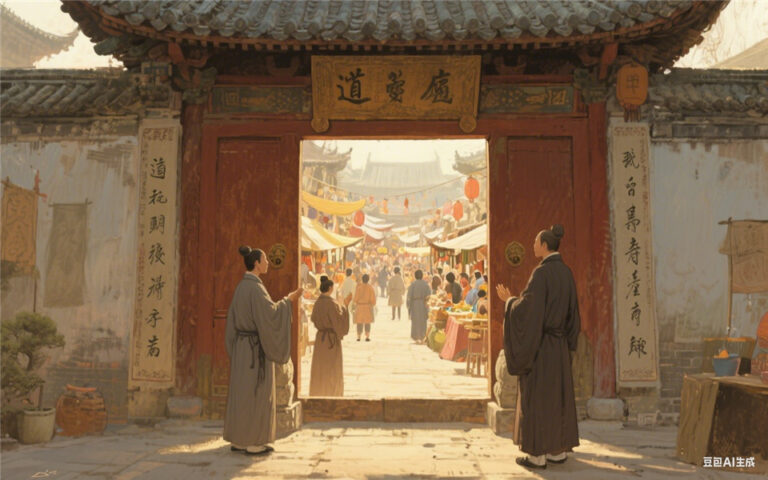
With the strong support of a wealthy merchant, Ai Langxuan left Qingxu Temple and established his own temple on Weihai Road, founding Tongbai Palace. In its early days, Tongbai Palace clearly defined its positioning: to focus on “scripture recitation” and ritual services as its core religious activities, while also operating a vegetarian restaurant. This operational model not only met the public’s demand for Daoist blessings and rituals, but also expanded the temple’s revenue streams through the vegetarian restaurant, laying the foundation for its stable development in its early years. The introduction of vegetarian meals not only met the dietary needs of believers after participating in religious activities but also became a distinctive feature that attracted ordinary citizens, enabling Tongbai Palace to stand out among numerous Taoist temples.
II. Prosperity: Wartime Glory Under the Protection of the Concession
The outbreak of the War of Resistance against Japan brought profound disasters to Shanghai and the entire country. Many religious sites declined due to the ravages of war, but Tongbai Palace, due to its unique geographical location, entered an “unprecedented” period of prosperity. Located within the concession area, Tongbai Palace was spared from direct wartime destruction during the occupation, becoming a rare “sanctuary” amid the chaos.
At that time, faced with the turbulent political situation, the public was filled with anxiety and unease, and the demand for religious solace reached an unprecedented high. Tongbai Palace, with its mature system of religious rituals and services, became an important place for the public to seek spiritual solace. According to historical records, during this period, Tongbai Palace’s “incense offerings were abundant, religious services were numerous, and the number of vegetarians was unmatched by any other Taoist temple in Shanghai.” Every day, devotees came in a steady stream to burn incense, pray for blessings, and request religious rituals. The sound of chanting and ritual instruments filled the air within the temple; the vegetarian dining hall was always packed, not only with devotees but also with many citizens seeking refuge from the war. Tongbai Palace reached the peak of its influence during the war.
III. Twilight and Decline: The Gradual Decline After the Post-War Prosperity
After the victory of the War of Resistance, social order in Shanghai gradually returned to normal, and the public harbored great expectations for a peaceful life, once placing their hopes for a better future in religious activities. As a result, the religious rituals at Tongbai Palace flourished for a time, maintaining some of the momentum from the war period. However, this prosperity did not last long. With the profound changes in the socio-economic landscape, Tongbai Palace gradually lost its former momentum.
On one hand, the post-war adjustment of Shanghai’s socio-economic structure shifted the public’s focus toward material production and reconstruction, reducing their reliance on religious rituals. On the other hand, the temple’s operational model failed to adapt to the new social environment, and without a charismatic leader like Ai Langxuan to continue guiding it, Tongbai Palace’s influence gradually waned. Subsequently, the number of devotees at the temple dwindled, religious activities decreased, and the vegetarian restaurant could no longer sustain itself. Ultimately, swept away by the tides of time, the temple gradually declined until it was completely abandoned, leaving only scattered memories of the Taoist history of Weihai Road for future generations to trace the trajectory of religious cultural changes in modern Shanghai.