
Shanghai Water God Pavilion: From Riverside Shrine to Modern Public Space
In the historical memory of Shanghai’s Old City, the Water God Pavilion once stood as a unique entity blending religious significance with local governance. Originally erected along the Huangpu River, this Taoist temple underwent centuries of transformation through wartime relocations, reconstructions, expansions, and functional shifts. Its century-long evolution mirrors the microcosm of Shanghai’s transition from a traditional port to a modern metropolis.
I. River Deity’s Protection: The Founding and Early Functions of Shuishengge
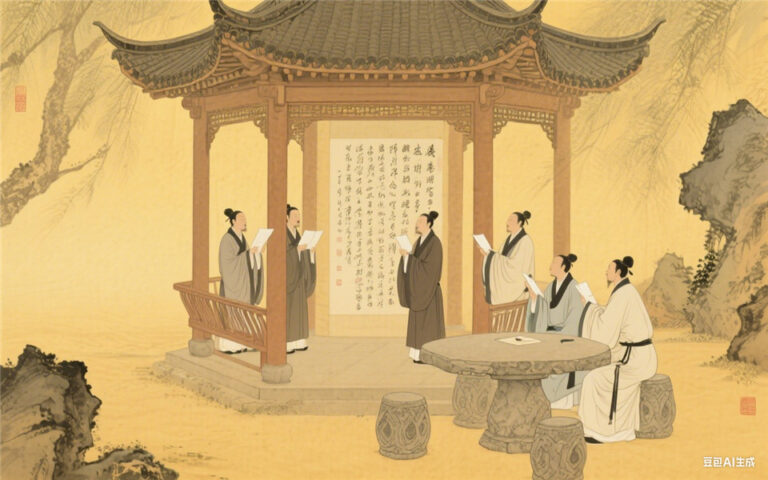
Originally built along the Huangpu River outside Shanghai’s Xiaodongmen Gate, Shuishengge’s location reflected profound geographical and religious logic. As a vital shipping hub along the southeastern coast during the Ming and Qing dynasties, the prosperity of Shanghai County was intrinsically linked to the river’s hydrological conditions. The establishment of the Water God Pavilion served both as a spiritual anchor for local residents seeking to “pacify the waters and ensure smooth voyages” and as a practical safeguard for shipping safety, reflecting the distinctive water deity beliefs prevalent in the water towns of Jiangnan. Functioning as a Taoist temple at the time, it not only provided a place for merchants to offer sacrifices and prayers but also played a vital role in regulating the spiritual lives of sailors, fishermen, and other maritime communities.
In 1853, the Xianfeng era of the Qing dynasty, the Xiaodaohui Rebellion erupted in Shanghai. Fierce battles between rebel forces and Qing troops raged within and outside the county town, reducing the Water God Pavilion to ruins in the conflagration. This 17-month conflict not only reshaped Shanghai’s political landscape but also unexpectedly prompted the Water God Pavilion’s relocation. Post-war, this structure bearing local memory was moved to the right of Cangqiao Bridge outside the county’s South Gate. Though distanced from the bustle of the Huangpu River, this relocation marked the beginning of a new chapter characterized by functional diversification.
II. Rebirth After Disaster: Functional Expansion and Management Transformation During Reconstruction
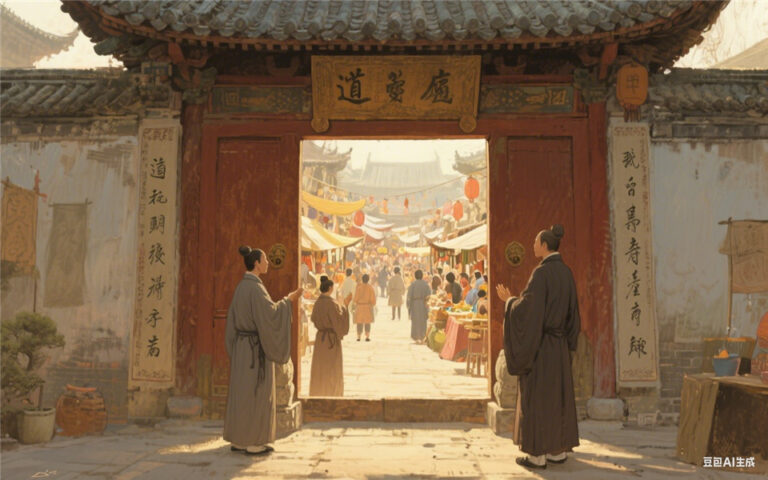
In the 14th year of the Guangxu reign (1888), Shanghai County Magistrate Pei Dazhong spearheaded the Water God Pavilion’s reconstruction—a pivotal turning point in its history. This restoration not only repaired the main “three-frame structure” but also acquired vacant land in front of the pavilion to build additional houses, creating a marketplace. This marked the first integration of religious space with commercial functions at the site. This functional expansion preserved the temple’s traditional public role while adapting to the growing commercial demands of late Qing Shanghai.
Post-reconstruction management underwent significant changes. Initially overseen by local gentry like Gu Mingzhao, Jiang Shu, and Xu Jiwei, these influential figures maintained daily operations through their social capital. With the rise of the local autonomy movement in the late Qing, the Water God Pavilion was taken over by the Autonomous Association. This transition reflected the era’s shift from traditional gentry governance to a modern local administrative system. The establishment and management changes of the market transformed the Water God Pavilion from a purely religious site into a public space combining commercial transactions and local governance functions.
III. Transformation of Old and New: Redefining Function in Late Qing Transition
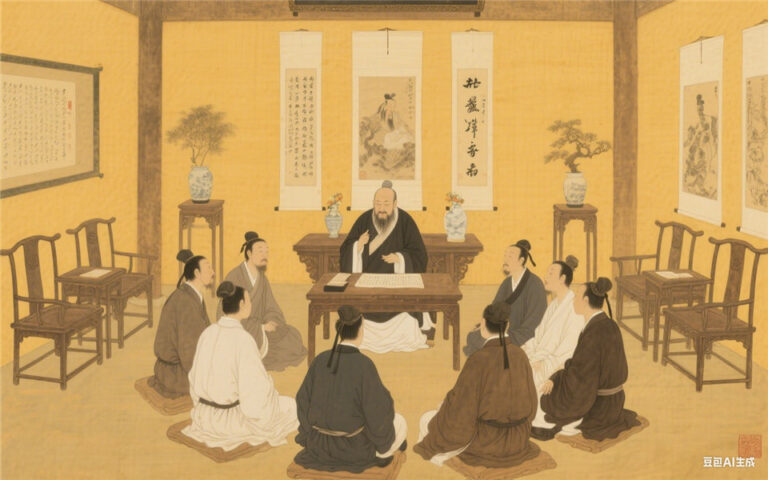
In 1911, the Xuan Tong era, the Shangxue Gong Research Institute was established within the Water God Pavilion, marking a pivotal leap from traditional to modern functions for the building. Amidst the implementation of the late Qing New Policies, various new-style associations and academic institutions emerged, and the repurposing of the Water God Pavilion embodied this era’s wave of change. The establishment of the Commercial Studies Institute introduced business education and academic research into this ancient structure, transforming it into a platform for disseminating modern commercial knowledge and advancing local industrial development.
From riverside shrine to marketplace, and finally to academic institution, the functional evolution of the Water God Pavilion consistently resonated with the pulse of Shanghai’s urban development. Though the original structure has faded into history’s long river, the historical information it preserves offers a unique perspective for understanding Shanghai’s spatial transformations, shifts in belief systems, and social governance during the modern era. The century-long journey of this building is not only a microcosm of local architectural history but also a vivid footnote to Shanghai’s transition from a traditional county town to a modern metropolis.